Understanding – Part 3
Scientology 1.0.0 – chapter 30
Survival drive
Lights! Camera (sight, sound, touch, taste, smell)! Action!
One of the most basic factors in life is perception. Perception is coloured by emotion, and emotions affect action. In Scientology 1.0.0, there is a scale of emotions, the Tone Scale, a scale that represents survival drive.
Remember, in Scientology 1.0.0, ‘survival’ means more than ‘the state or fact of continuing to live or exist, typically in spite of an accident, ordeal, or difficult circumstances’; it means ‘succeeding in overcoming counterforces in order to expand; to become more; to improve; to get better’.
The added definition stems from the non-static nature of the universe, where nothing, absolutely nothing, remains still; everything is constantly in flux. In other words, even maintaining an apparently stable condition requires accommodating continual change.
Things are always either expanding or contracting, becoming more or less, or this rather than that. Whether or not the universe is getting better or worse, who knows? As for us humans, we are either improving our ability to handle all this dynamic and constant change or we end up in Hell. Understanding Natural Law is the first rule in the Game of Change; the second is to either work with it or get squashed like a bug (which might explain to the more squeamish why a supposedly fearsome and vengeful God could be such an old meanie).
As for the word ‘drive’, it means the urge or force to move in a specified direction.
There seems to be a fundamental drive: to grow and improve—the drive for greater survival. When one fails at this, one enters a downward spiral, resulting in… getting squashed like a bug. One either gets better at survival or else. If you don’t want things to go blooey, then you must keep striving.
But wait! Actually, if you understand what happens when emotions below 2.0 become misemotions, you’ll notice that there appears to be a second drive: the drive towards extinction. That is to say, there is an actual urge to succumb; a person or group descends into the lower tones, and extinction appears to become the goal. In essence, life below 2.0 is so unpleasant that it seems like a great idea to get it over and done with.
This does not necessarily mean that a person consciously wishes to die. Indeed, they often sincerely believe that everything they’re doing will help preserve their existence. Nevertheless, within this theory, their prevailing emotions and behaviour increasingly undermine the very survival they are attempting to secure. In other words, the drive towards succumbing describes the direction in which their lives are heading, regardless of their conscious intentions.
One of the practical uses of the Tone Scale is the prediction of behaviour. Each level of the scale has associated with it certain characteristics and patterns of behaviour. By observing these patterns over time, one can begin to establish the prevailing tone of an individual or group and, in turn, anticipate other behaviours characteristic of that tone. The emphasis here is on patterns of conduct, not on what individuals or groups profess to believe or intend.
Unfortunately, succumbing is rarely a quick and tidy affair. People can linger in these tones for whole lifetimes, creating havoc for themselves and misery for everybody else. And forget about groups getting in this extinction frame of mind; when they get stuck, now you’ve got a whole collective, possibly a whole nation, bent on destruction.
Understanding this, coupled with the fact that some individuals and groups actively strive to become zippo, could potentially unlock the mystery behind a multitude of truly bizarre human behaviours. Just look through the Diagnostic and Statistical Manual of Mental Disorders, Fifth Edition to see what I’m saying, and it only catalogues a few of the really the really obvious cases. Far less obvious are the many behaviours that are considered normal or even laudable, such as getting rich or famous without doing anything valuable or the deplorable U.S. federal government profiting from the deterioration of society. Other examples include the creation of fake money by financial cabals, the design of addictive algorithms by Big Tech, the promotion of permanent illness by Big Pharma, and the perpetuation of worldwide conflict to support the utterly insane military-industrial complex.
In terms of inorganic material, death seems to be neither here nor there. For ‘unalive’ matter, one could say that the fluidity of a thing ‘dies’ when it freezes, or the solidity of something ‘passes away’ when it burns up and becomes smoke. Much of what was once living matter decomposes, returning nutrients to the environment and contributing to the formation of things like soil. Without soil, a whole lot of life cannot exist. As for us humans, though, death seems to be something of a problem. Unless we are very old, sick, or injured, we don’t particularly like death. We don’t want to die and would rather live for as long as possible. Many of us, anyway. Even most of those stuck below 2.0 don’t want to die; at least that’s what they say, although practically everything they’re doing almost certainly guarantees it. Yep, based on this scale, the confusion surrounding survival can escalate to the point where succumbing becomes a purpose, with death as the ultimate goal, as crazy as that may sound.
Unfortunately, many people who are aware of this scale tend to ignore its two parts, leading them to endorse individuals and groups below 2.0 with justifications such as, ‘Well, I really like them’. Or, ‘They mean well’. Or ‘There’s no choice’. Of course, it is impossible to avoid low-toned individuals and groups, such as some family members or our governments and financial institutions; whether one chooses to like or dislike them is a matter of personal preference, but one should identify and label them correctly so as to minimise any support for them. If possible, avoid supporting them altogether, especially if you value the future.
Remember the lockdowns? The government, WHO, CDC, mainstream media, Bill Gates and Anthony Fauci all employed fear tactics to maintain control over the population. To a person who properly knows this scale, this tells them that something was seriously wrong—and it weren’t just no virus neither.
The first point of knowing this scale is to help one to decipher this hard and chilling fact: individuals or groups permanently functioning below 2.0 are dangerous regardless of their denials and statements to the contrary; just look at what tone level they are habitually using to control others and the environment, and you will have a pretty good idea of where they’re headed. Because these benighted souls are so often continuously bloviating about their virtues, duties, and sacrifices for the betterment of this or that, it can be missed that they are, at the end of the day, simply ‘on a succumb’ and would like nothing better than to take you along for the ride. People stuck in fear, for instance, say they don’t want to die ever, really literally never, but their regular habits and routines, deeds, activities, and conduct flirt with extinction nonetheless, often sooner than later. You know: cowards die a thousand deaths before they actually die.
So, this Tone Scale is pretty useful in showing where anyone actually is regarding these two goals as well as giving a clue as to how they’re going about accomplishing them.
Above 2.0, individuals and groups are surviving more than succumbing. Below 2.0, ’tis the other way ’round.
Simplicity
‘People and groups are either “working to get better or working to get worse”? Bah! Too simplistic!’
The principle of the mandate — survive! — and then its division into two drives might seem overly simple, a fairly common criticism regarding certain Scientology data. Perhaps this is the case, but understanding any intricate subject begins with knowing its basics. Even those subjects that are wildly complex, you know, like… life. If someone is teaching you a subject and you’re struggling to understand it, it’s likely because they haven’t adequately explained its fundamentals. The trick to understanding any subject is to begin with its foundations, which are often simpler than the complexities built upon them.
Take white light, for instance. Using the three primary colours of light—red, green and blue—we can produce an extraordinary range of colours. Fine. If you have good colour vision and look around, you will quickly notice variations not just in hue but also in saturation and lightness. When you incorporate the characteristics of light sources, reflection, and absorption, the array of colours becomes innumerable. Include shape and texture and you have… everything (except for the invisible stuff, of course, which accounts for roughly 95% of the universe’s mass-energy content). From one simple factor, white light, a whole world of colour can be studied and understood. If you’ve ever taken a comprehensive class in art, colour theory and practice are huge subjects. Little ol’ white and so much to know—so much to see! Go figure.
But when it comes to human beings, many experts in many spheres of thought regarding human psychology prefer for some reason to be overcomplicated. Much of psychology fails to grasp this fundamental truth—the simple fact of a single basic drive: survival, which can be broken down into two parts: survive and succumb. Sure, the permutations of survival and non-survival, creation and destruction are many, varied, and vastly complex; they got that right. However, this straightforward dichotomy serves as a valuable foundation for evaluating the intentions and actions of any group or individual.
Again, above 2.0 are the more survival-oriented emotions; life is the purpose. Below 2.0 are the non-survival emotions, where death is the purpose—that is, of course, if and when one is stuck in them or is experiencing them inappropriately (misemotion).
Trapped below 2.0, a person begins to destroy one or more of their many symbionts, which are essential for their own survival. For instance, a group under 2.0 might cut corners, thus polluting the environment and killing off farms and there goes dinner.
The emotions related to survival lie above 2.0. 2.1, which might be called ‘Deep Monotony’, up to 2.8, Contented, are not particularly energetic in terms of survival behaviours, but they’re not destructive either, although they can neglect the destructiveness of others, and that’s not good.
2.9 and 3.0 are more active, but they’re still not paying enough attention to their symbionts to survive in the long run.
Above 3.0 is where reason and creativity lie. This implies that individuals are now actively shaping their own lives and the world around them, while also effectively assisting their symbionts.
Above 4.0 is self-transcendence, where lies even higher survival potential.
However, survival is impossible without understanding.
Understanding
Going deeper, the Tone Scale represents a scale of understanding.
Understand means to comprehend, grasp the idea of, or receive from a word or words or from a sign the idea it is intended to convey. From Old English understandan, probably literally ‘stand in the midst of’ (note: this interpretation is not universally established, but I like it), from under + standan ‘to stand’. According to this interpretation, the term ‘under’ does not imply ‘beneath’, but may derive from Old English under, which is derived from Proto-Indo-European nter-, which means ‘between, among’. Stand comes from Middle English stonden, from Old English standan, ‘occupy a place; standing firm’.
This suggests an interesting way of looking at understanding: standing amongst things, rather than apart from them. And that brings us to cooperation. To increase one’s chances of survival, such as by building advanced civilisations, for instance, cooperating with others, groups, and the myriad of symbionts entailed in the organic and inorganic realms is necessary.
To figure out how to achieve cooperation, understanding life better is requisite, and a scale that shows not just how much one understands, but the nature of that understanding, could be useful. At the lowest point, 0.0, there is insufficient understanding and, consequently, no chance of survival. At the upper end of this portion of the scale, at 8.0, there is much more understanding and a great deal more survival.
In Scientology 1.0.0, the three components of understanding are affinity, reality, and communication, commonly referred to as ‘ARC’.
The equation is: ARC = U.
Communication
Definition: the imparting or interchange of thoughts, opinions, or information by speech, writing, or signs.
The Scientology 1.0.0 definition of communication goes somewhat further: it is the action of impelling an impulse or communication particle from a source point across a distance to a receipt point with the intention of bringing into being at the receipt point a duplication and understanding of that which emanated from the source point.
Just because people are talking at one another does not mean they are communicating; just watch most talking heads on TV. The word comes from Latin communicatus, past participle of communicare ‘to share, communicate, impart, inform’, literally ‘to make common’, related to communis ‘common, public, general’. When we look up ‘common’, it means belonging to all, owned or used jointly, general, and of a public nature or character. So, conceptually, if communication is occurring, then whatever is communicating is communing with whatever or whoever is being communicated to.
To commune means to converse or talk together, usually with profound intensity and intimacy; to exchange thoughts or feelings; to be in intimate communication or rapport. Seems to me this communing business would not occur without those so engaged understanding one another.
Conceptually, then, communication might be understood as two or more people together (between, among), standing firm (cooperating) by means of understanding one another.
Duplication
But if there is to be any actual communication, there must first be duplication.
Note my father’s definition of communication: ‘…with the intention of bringing into being at the receipt point a duplication and understanding of that which emanated from the source point’. This is a crucial aspect not found in other definitions of the word.
Duplication is defined as ‘making an exact copy of something’. It comes from late Middle English (in the sense ‘having two corresponding parts’), from Latin duplicat– ‘doubled’, from the verb duplicare, from duplic– which means ‘twofold’.
One day my dad and I were talking about learning—about acquiring knowledge in general and studying his work in particular—and I asked him about how one goes about getting people to understand Scientology. He responded, ‘No, no, that’s not the job. The sole responsibility is to ensure that a student duplicates the material in such a wise as they can apply it, at least rotely.’ I puzzled over this until it dawned on me that you can’t get anyone to understand anything; that’s up to them; that’s their own determinism, but you could succeed in getting something or some subject duplicated (provided the person at the other end is willing, of course). Only after duplication could understanding then be worked on (provided the person at the other end is still willing, of course).
It could be argued that almost every conflict between two persons or groups resulted from a breakdown in communication. In such a case, an investigator might readily discover that one side did not first duplicate what the other side was trying to say. You know, such as after a massive row, Sally and John finally find out that when he said, ‘Watch your cat’, she thought he said, ‘Gosh, you’re fat’.
Although you can’t actually make someone understand your meaning—perhaps it’s beyond their comprehension, or your meaning is obscure, as it is with all esoterica, for example — you can make sure your interlocutor has duplicated you and the words you used. In reverse, when puzzling over another’s communication, first make sure you’ve duplicated them and then work out if you’ve understood what they’re saying. This is where the practice of ‘steelmanning’ becomes useful. Having first duplicated what another person actually said, one can attempt to reconstruct the strongest version of their argument, testing whether one has understood not merely their words but the reasoning behind them. By strengthening their argument, you may demonstrate not only that you duplicated their communication but also that you understood it.
Therefore, when communicating, especially complex ideas, it is advisable to ensure that what you’re saying can be duplicated and that the person receiving the communication has duplicated it. Then you might work on getting yourself understood; see if you can’t get them to steelman you.
Establishing the understanding of anything is, of course, a vast subject, especially with something like Scientology (as I am trying to say with all these ‘blogs’), but without ensuring duplication of what is being conveyed as a first step, comprehension is just plain impossible.
Reality
Reality, as it is commonly defined, is the state of things as they actually exist, as opposed to an idealistic or notional idea of them. In Scientology 1.0.0, reality is simply defined as agreement as to what is.
Here, ‘reality’ concerns what individuals agree to be real. This is not necessarily the same as objective reality: people can agree about something that is false, just as they can disagree about something that is true. Nevertheless, establishing what people actually agree upon is an important part of communication and cooperation.
This encompasses both objective reality and an individual’s thoughts, feelings, and beliefs. In many cases, sharing these sorts of things among two or more people can facilitate further communication. Bob loves Mozart, and so does Sue. This leads them to discover even more realities in common, and they become friends. One way or the other, establishing what is real between individuals and groups can lead to further communication and the possibility of improved cooperation.
Affinity
Affinity is love or liking for something or someone. The Scientology 1.0.0 definition is: a phenomenon of space in that it expresses the willingness of someone or something to occupy the same place as the person or thing that is loved or liked.
Communication and reality without affinity aren’t going to get one very far in achieving long-term cooperation, though. Without affinity, misunderstandings regarding ‘what is’ are more likely to ensue because if the desire to occupy the same space is not established, then there’ll likely be no further communication.
So, ARC (affinity, reality, communication) equals understanding, and understanding is obviously a good thing. But what about love?
Love, as it is commonly defined, is an intense feeling of deep affection. That’s the highest degree of affinity, up near the finest of all wavelengths. It’s a strange world, though, where the word ‘love’ gets bandied about as much as it does, all the while any actual comprehension of the object of that love so often goes begging. This can only mean that actual ARC is missing. However, one can use affinity to initiate communication and thereby establish reality. Increasing one’s liking for another brings one closer to the person or thing in question, facilitating further communication and thus allowing one to establish a firmer reality, potentially leading to deeper affinity and cooperation.
At 4.0 and higher, where proper understanding can be found, one may experience actual love for anyone or anything.
The triangle
Okay, there it is: since understanding is composed of affinity, reality, and communication, then the greater the amount of ARC, the more understanding there is.
In Scientology, the three components are understood to be interdependent: increasing one raises the other two, while decreasing one lowers the other two. For this reason, A, R, and C are depicted as forming an equilateral triangle. The size of the triangle represents the magnitude of understanding. Its equilateral nature symbolises the interdependence of the three components.
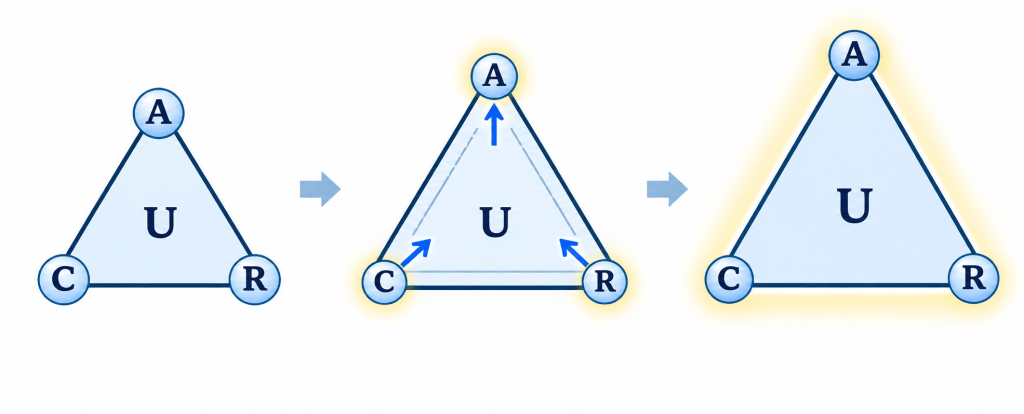
Thinking about alchemy. You can use this triangle for transformation, shifting from one level of comprehension (emotional tone) to a higher one on the scale. As communication improves, so does one’s reality and affinity. Enhancing one’s reality also enhances one’s affinity and communication. As one’s affinity increases, one’s communication also improves, which in turn enhances their reality. This process continues as one progresses towards greater levels of understanding.
Weaponisation
Of course, the reverse effect may be achieved, especially with communication. Remember back in chapter 2, the business with viewpoints and dimension points? That’s communication in a nutshell.
One thing to bear in mind when opening a line of communication is that that with which one communicates also communicates with one. Consequently, a communication line can be used to diminish ARC just as readily as it can be used to increase it.
Have you ever spent an afternoon with someone who does little else but complain? There may be some legitimacy to every one of their complaints, but how enthusiastic about life were you by the end of the afternoon?
Or try this experiment: check your energy and aliveness and get a measure of it. Then sit down and watch the evening news; afterwards, check again to see how you feel. There’s a reason for the old expression in the news business, ‘If it bleeds, it leads’. Imagine cultivating a circle of acquaintances who communicated with you almost exclusively about catastrophes. How long would you want to remain in communication with them?
Now, if someone wanted to diminish your understanding of things, they could do so quite effectively by exploiting an established communication line. They could enturbulate you (cause you to become turbulent, agitated, or disturbed), misrepresent facts so as to undermine your reality, and foster antipathies where once there was affinity.
And there you have it: the ARC triangle in reverse.
Sum
Each tone (emotion) represents a specific magnitude of ARC and, consequently, a specific grade of understanding. Below 2.0 on the scale, there is less ARC, which implies limited understanding and, consequently, less ‘right action’ (or right inaction), leading to decreased survival. The higher on the scale, the higher the ARC, the better the understanding and the righter the actions (or inactions). If one works the triangle with attention and skill, it’s possible to rise up the scale.
With the levels of understanding achievable by persons in the tones above 3.0, right action becomes increasingly possible, particularly when the correct information is at hand. After all, not every problem requires a solution, and not every solution requires action.
Right action and inaction are the whole point of understanding.
Understanding is the whole point of Scientology 1.0.0.
Next: ratios of matter and understanding


3 responses to “Survival”
Hi Arthur,
Another fascinating article thanks!!
I was going to comment the below on your blog, its been on my mind a lot lately and seems to fit with your article, from my reality, but not sure if its the sort of comment you would want.
Use it if you want.
Kind Regards Brian
In this day and age, I am struck by the amount of misinformation. I hate to say that word because it has been so skewed and used to obfuscate truths. But frankly facts are hidden from us in this society. I think if we knew our actual history as a race, knew the forces that shaped that history and knew the current forces and their actions as a group we could find agreement to go forward. Even the truths your father presented to us, so many of which proved to be true as evidenced by the working of them. The lengths to which he was attacked is staggering. I am coming to the conclusion that while those forces continue to dominate and actual truths kept from us, ARC as a group is going to be very difficult.
>
LikeLike
Thank you, Brian. I value every comment, even those that may be critical. I mean, who wants to live in an echo chamber? Your remarks, though, are exactly what I am talking about. Without accurate information, there’s no possibility of making the course corrections that are necessary to maintain a viable society. My dad’s writings from after 1950, especially those from 1951 and 1952, provide a wealth of information on this topic.
LikeLike
So real and brilliantly presented Arthur.
Thank you.
Barbara
[image]
LikeLike