The Wild Mind – Part IV
Scientology 1.0.0 – chapter 11
Psychology – Who’s who
Actually, I just sort of shoehorned this into the list of the kinds of mentation that I think had to be a part of man’s development as he moved on into his civilisation phase.
The study proper of human behaviour starts, sort of, in the seventeenth – eighteenth centuries with Leibniz (1646-1716). Psychology, though, doesn’t actually become a subject until the 1870s. Of course, this is long, long after the advent of Western civilisation. As such, modern psychology is an extremely recent discipline, is generally rooted in materialism (less so lately), and has traditionally attempted to study human behaviour mostly from the stimulus-response perspective.
Materialism
In Scientology, much is made of the fact that psychology today means “study of the mind”, whereas before “psyche” originally meant “soul”. This distinction is made and given emphasis because of the current battle between the ideas that assist mankind and those that harm. The distinction is materialism.
Materialism is the philosophical theory that regards matter and its motions as constituting the whole of reality (emphasis mine) and all phenomena, including those of mind, as due to material agencies. This is opposed to Scientology’s metaphysical view that ultimate reality isn’t material. This idea of a transcendent (metaphysical) reality has actually been most of the planet’s view for almost all of history; only in the West and only in the past couple hundred years did certain people start to formulate the idea that the universe is an infinity of mostly insensate (dead) matter.
This definitional transformation from soul into mind is important mainly because it’s a grave prepositional error: the mind is something you can look at, use, it’s a tool, and it’s the soul does the looking; you are the soul, you own a mind; making them the same thing gets rid of the soul, and now you have what is, in effect, a machine, a profaneness. In addition to that construct, materialists define mind as brain; defining “mind” as “brain” is a little like defining the internet as your laptop; these are, in fact, dangerous conflations and too reductionist as they tend to shut the door on asking more questions, and it’s more questions that are needed.
As for the Ancients, there was no distinction between mind and soul. The mind became a distinct idea from the soul with the advent of the Enlightenment because of its emphasis on reason; and thus was brought to light, at long last, the Sovereign Individual. This fundamental distinction was key to the following boom in technologies, including Scientology 1.0.0. Because in materialism, mind and soul are the same thing, materialism sets the clock back and dashes man’s hopes of going forward.
(This thing, materialism, will be mentioned a lot because it is a key concept related to the confusions I am attempting to, if not dispel (if only one could!), at least somewhat clarify.)
Proto-psychology
As far as the kind of “psychology” I’m referring to here in this article, though, it is simply the observations man had to have made, back in the day, about his fellow man as to motivation in order to develop the level of cooperation necessary for any sort of society to exist.
Psychology had to be a major factor in man’s thinking a considerable time before what I guess we refer to as “religion”, the advanced sort that goes with civilisation, which is the next rung up. If you don’t know, can’t predict, the quirks (and everybody is peculiar) of the other guy (or gal), even in a group as small as two people, then you’re not going to work well together. Because that’s about as tough a problem as there is, you’re going to do a better job at it if you know the general behaviours of individuals and groups; you’re going to need to work out some sort of pattern recognition in order to figure out quickly who’s who. Fortunately, general behaviour does follow patterns, which is what psychology is all about.
I have this laid out this way because one of the previous rungs on my “ladder” (The Wild Mind, part I) was myth, and the next one up is religion. Many myths seem to be all about general behaviour, often using what Jung called archetypes, whilst religion appears to be the principles and behaviours grounded in good versus evil. Therefore, psychology fits in somewhere, and I stuck it in between myth and religion.
Psychology runs deeply all the way through many myths (and folk tales) and through all religions. I see myth, psychology, and religion as intimately and inextricably intertwined, part of the blueprint for the advanced level of human cooperation that results eventually in complex civilisations and the concomitant rise of the technologies, specialisations, and social institutions necessary to build them.
That’s all about that. For now.
Religion – good versus evil (order vs. disorder)
Note: This next subject is as vast, complicated, and confused as almost any other I can think of (I’d guess that there’s been more written on religion and religious matters, both pro and con, than just about any other subject). I’m afraid, as a result, I’ll be skipping around a fair bit, more than usual, and may possibly even mangle the subject hopelessly. Therefore, as a reminder (and disclaimer), because so many people will know a lot about this stuff anyway, these articles are my thoughts about all these subjects: magic, religion, philosophy, and so on, rather than any attempt at learned descriptions. What you are reading is my endeavour to paint a background as I build an argument for a world in which Scientology becomes possible, even inevitable. So, I hope you’ll have patience with me as I muddle my way through and, perhaps, even find it a little interesting.
When I was growing up, Scientology was never a “thing” and things like God and religion were never discussed as if they were “other things”. These subjects were all of a piece, for me anyway, and were a little like that joke: two fish are swimming along, and a bigger fish comes by, says to the little fish, “How’s the water?” The little fish swim on for a minute, then one of them, puzzled, asks the other, “What’s “water”?” I suspect religion must have been this way for most people through most of history.
When I turned five, for instance, my parents sent me off to school. The school introduced me to the Anglican Church, where I actively participated in prayer and hymn singing. I thought it was fine; there was no conflict with Scientology; Christianity wasn’t “something else.” It was water.
Even by the late 1960s, as Scientology 3.0 was coming more into existence and the Church of Scientology was assuming a more overt religious image, there was still no discussion that Scientology and other religions were distinctly different things; it just wasn’t an issue. Scientology was non-denominational after all and welcomed all religions, not just the followers of Christianity. There was no plan for others to give up their religions in order to use Scientology procedures. It was only when the Sea Organisation came into existence did one begin to hear that there were important differences between ourselves and “other practices.”
The Sea Organisation is the senior management instrument of the Church of Scientology and is characterised by its paramilitary culture. As such, it tends to hold very strong views about the differences between itself and the rest of society, just like any group does that has a mission to change the shape of the world.
This view did not just “happen” because the Sea Organisation came into existence; this view was primarily influenced by the global shift towards a more secular and even irreligious world. In the Sea Organisation, there has been a more strident effort within its ranks to distinguish itself from all the growing confusion and hostility around religion. During the late 1960s, a significant demographic emerged, asserting their cultural dominance and perceiving themselves as too intelligent to subscribe to simplistic beliefs like Christianity, and it was these young folks that were mostly making up its ranks.
This meant that more and more of the people who were getting involved in Scientology were atheists, therefore importing the fundamentalism (black and white thinking) that often goes with the idea that there is “no God.”
In the mid-1970s, I briefly went to college and came into full contact with the hard-core atheism and anti-religious culture prevalent among the world-weary twenty-something illiberals of southern California. At that school, I encountered individuals, both faculty and students, who viewed any hint of religion as, at best, naive and, at worst, evidence of a dangerous degree of stupidity. And forget anything resembling a fringe “cult,” as they considered Scientology to be; now that was really going off the freaky, deaky deep end, as they, in no uncertain terms, let me know.
Because my father was fully aware of this specific fear, fanned by the press as it was (and still is), he arranged for me to matriculate under the name Conway, but despite that precaution, my actual identity leaked out, and by the end of the first semester, you would have thought I was carrying the plague.
Anyway, these were the experiences that finally got me seriously pondering religion and the role it plays in foundational thinking.
As for contemporary art, which was the reason I was at that school? It too seemed to have devolved into a culture of cynicism and resentment as well, although it masqueraded as irony. These were, for me, a couple of the biggest mysteries; perhaps there was a connexion?
During the brief time I spent with my father after leaving college, we discussed the issue on numerous occasions. He felt the rising tide of confusion about religion was catastrophic and said it was his hope that religion would come back into Western culture and society before it was too late. This idea went straight over my head at the time, but I eventually got to thinking about it in earnest when I returned to studying art eight years later.
I’ve been working on trying to figure all this out ever since, and a few of the thoughts I’ve had about this stuff are put forward here.
Religion and infinity
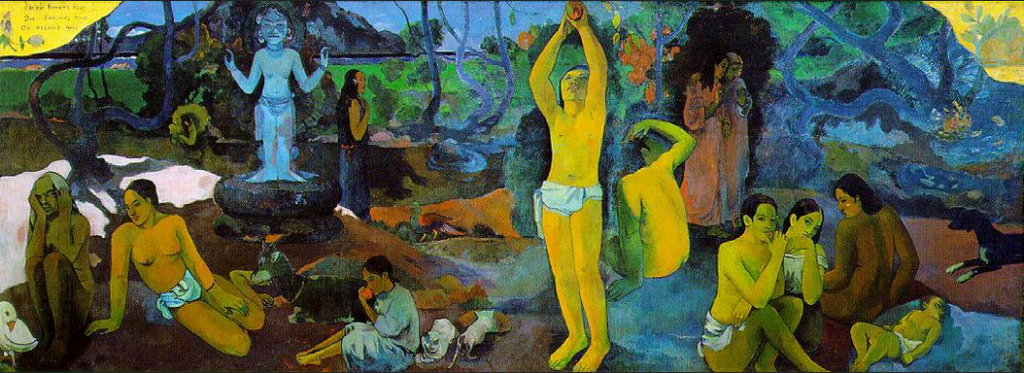
Awe, art, rituals, magic, myth, mysticism, and psychology are all embraced by, and incorporated into, the next rung up on the ladder, which is religion.
Okay. So the rare mystic joins with the absolute, sees reality as it actually is, and is joyful. And wise. But, what about the rest of us? Is there no way forward and upward?
Each of us (anti-socials, not so much) wants basically two things: to survive as long as possible (with the least amount of pain and the most pleasure that may be our due), and to expand. Our culture today shows us the most obvious path for expansion (besides having children): more influence and stuff. However, anybody who is going to be perfectly honest, after they accumulate a certain amount of stuff, will admit to eventually hitting some sort of invisible ceiling, and then things begin to wane and become dull, even painful.
So. There is the infinite.
Now, physicists seemingly know this in spades, but the way some of them describe it has the rest of us thinking about slitting our own throats: infinity is a cold and indifferent vastness of mostly empty nothingness; what few billions of galaxies it contains are spinning away from one another, eventually to such distances that no light will reach anything, leaving behind a frozen black void that cannot be conceived. Or something equally cheerful. Bottom line: “Life is meaningless.”
This grim vision is perhaps the result of the formula for infinity that they’re using without realising it: that it has a 1 followed by an infinite number of 0s, which would actually be a misconception. The actual formula would be: ∞ . No 0s, no 1s. Sometimes the way something is (∞) is confused by how we think/feel and therefore behave. We can accidentally “think” of ∞ as lots and lots, overwhelming lots, of stuff. At least, that’s what I think the physicists who prop up the “meaninglessness of life theory” are “thinking.”
Possibly some mathematicians will begin objecting to this. No, no, they’ll say, of course we don’t think infinity is a 1 followed by an infinite number of 0s. Sure, sure, I’ll say, but it is exactly that formulation that produces such a dark and depressing portrait of ultimate reality. So, therefore, that’s the way many of them are actually thinking about it. Thinking about things assumes that you can know something analytically. Infinity is something no one can know about in that way. The trick is not to think about it; the trick is to know it without thinking about it.
And this is where religion comes into the picture.
Here’s my synopsis:
The universe is magnificent, beautiful, and therefore good. Something authored it and made it. It is full of force. The author is intelligent, so intelligent life in this universe is inevitable (boy, can that be energetically argued by some people!). Life is magnificent, beautiful, and therefore good. Man, standing between Heaven and Earth, is the incarnation and personification of this intelligence: the Logos. In other words, man is the embodiment of reason. But for man, force has an “upside”: pleasure, and a “downside”: pain. Pain is, in fact, deeply necessary and therefore good, but too much pain makes some people unreasonable. Unreason is evil.
Religion and emotion
So. The universe is good. The Earth is good. Man? Maybe not so much – this guy has to be guided to the good, apparently.
Maybe because most men can be guided and actually get better and better, that makes them good as well.
Perhaps the ability for men to be good stems from the universe’s “desire” for ethical unity, an inherent good order built into the cosmos (the word “cosmos” refers to the concept of the universe as a well-ordered whole). Even so, there is evil, and it’s in the world by the boatload.
In a previous article (Space, Emotion, and Well-Being), I discussed the Tone Scale in Scientology 1.0.0. This scale not only posits how a person perceives the world, as perceived through the emotions they may experience momentarily or permanently, but also guides their actions accordingly.
For instance, at the top end of the scale, a person will discover that ∞ is the only way forward for personal growth. To them, ∞ is ultimate love, something to, at least, be aware of. Perhaps one day, even something to be fully experienced. To a person lower on the scale, ∞ is meaningless. This is partly because, as you go down the scale, you begin to “know about everything” (hubris), and partly because anything that is not material, that cannot be measured, is nonsense. Meanwhile, for such a person, all things are starting to look pretty much like everything else anyway, and all morality, like objects and stuff, is therefore “relative” (a word that has come to be confused with “subjective”). And, since everything is relative, including love, then nothing really matters, so it might as well be a dog eat dog world: may the most cunning and ruthless among us win! (preferably themselves). A simplistic explanation, perhaps, but that’s the concept.
The Tone Scale (the limited one I described in that article; there’s a lot more scale actually) is also a scale of analytical thinking versus stimulus-response behaviour: at the top end is reason; as you go down the scale, reason gives way to stimulus-response – because, when emergencies crop up, one needs to act rather than think about it. And below that, stimulus-response becomes apathetic as in opossum tactics, the perfect stimulus-response when one is dealing with overwhelming odds. Stimulus-response isn’t unreason. You want and need it. It’s only unreasonable if one gets “stuck” in it after the emergency is over.
Religion is a tool. In the hands of a reasoning individual, it’s an organising principle extending from ∞ that shapes, edifies, coheres, and beautifies. In the hands of an unreasonable individual, it is oppressive, divisive, and ugly, sometimes even violent.
Consider everything in the world that has potential for both good and evil. Well, heck, that’s pretty much anything and everything. But “religion” became “triggering” over the years because, unlike most other things, it is sacred. To weaponise the sacred is a great blasphemy, probably the greatest of all crimes. In fact, this kind of blasphemy is the point of the first of the Ten Commandments, which goes, I am the Lord thy God; arguably, even the first four. Why? Weaponising religion means putting oneself before God, something all narcissists do, such as dictators, bureaucrats, TV pundits, etc.
Definitions
The usual definition of religion: a set of beliefs concerning the cause, nature, and purpose of the universe, especially when considered as the creation of a superhuman (as in above or beyond human) agency or agencies, usually involving devotional and ritual observances, and often containing a moral code governing the conduct of human affairs.
A better worded definition might be: a set of concepts concerning the cause, nature, and purpose of the universe, especially when understood to be the creation of an omnipotent agency, usually involving devotional and ritual observances and often containing a moral code governing the conduct of human affairs as well as binding them to a higher power, resulting in improved survival.
The derivation is: Middle English (originally in the sense ‘life under monastic vows’): from Old French, or from Latin religio(n-) ‘obligation, bond, reverence’, perhaps based on Latin religare ‘to bind’. To bind – very interesting.
Besides the fact that today one hears the word “religion” constantly uttered as if it were synonymous with superstition, hive-mind behaviour, or some other kind of nonsense, religion is variously redefined.
Here’s the definition of religion as used by the mainstream media: the belief in and worship (co-dependency) of a superhuman (Marvel comics), totally controlling and all “seeing” (as with actual eyes), especially as in a personal God or gods (narcissistic conceit). Whoops!
In religion, one acknowledges that there is indeed a God, the Great Mystery and Power of existence itself, and offers thanks. Gratitude plays an enormous role in a fulfilling and successful life. The mere fact of being thankful for the personal miracle of being alive is Big Medicine. Unless one is a colossal screw-up, the opportunity to be alive is a wonderful thing.
Religion also sets forth the ideals of existence, the ideals that each person must try to live up to, the ideals by which each person must necessarily be judged. Even the decision not to judge is a judgement. (Usually a useless one, but still a judgement.)
It’s this strong organising and civilising principle in religion that coheres groups and societies. To guide people towards these ideals, you must have a concept of the sacred, the observation that there are actually things in the universe that are so senior to all other things that messing with them is just plain suicide.
As for the word sacred: it comes from the Latin sacrare, from sacer, ‘holy’. Definitions tend to get circular on this one, as you can guess, so straight to the derivation: Holy, from German heilig, heil, ‘healthy’ and Old English hǣlth, of Germanic origin; related to ‘whole’. Hmm.
God
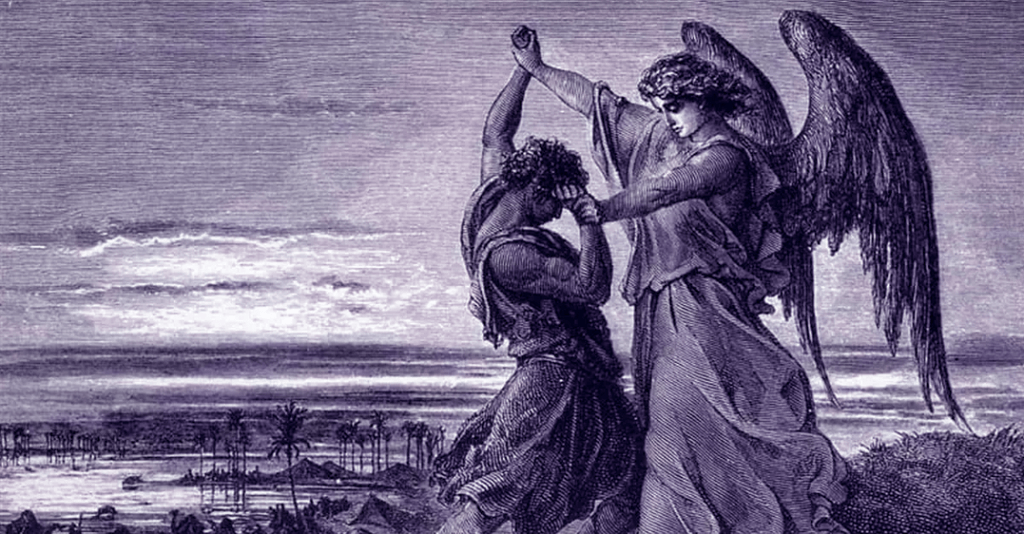
And he said, “Thy name shall be called no more Jacob, but Yisra’el: for as a prince hast thou power with God and with men, and hast prevailed.” – (Genesis 32:28.) Yisra’el, or Israel, means “one who struggles with God.”
Well, who, or what, is God anyway? Well, I surely can’t tell you, but I do know that there’s no way most of us have not given this serious thought.
Maybe God is the big idea—the idea that transcends time and space, exists beyond consciousness, is the Prime Mover Unmoved, the First Cause, the Ground of All Being, and so on. Or maybe God is the Supreme Being or Sublime Awareness, or maybe something even bigger yet: the Absolute or Infinity (∞). The problem with discussing the ineffable is that it’s ineffable. If you discuss the ineffable, then it’s effable, and the ineffable isn’t. (Effable, I mean.)
The big mistake, though, I feel, is discussing God as if this is a person, or any sort of bounded being (such as proffering that God could have been an alien or an alien species). The mainstream media just loves to do this, but it tosses the conversation down the toilet. (It is true that Jesus was a person, but this was an incarnation, which is a wholly different thing.)
One thing’s for sure: whatever God is, it is something so profound, so fundamental to reality, that there’s no wishing it away. So much so that once you’ve “killed Him off,” you end up “worshiping” instead, in the most nauseating way, the state or some defunct ideology.
Moving along. God, although a deep mystery, can yet be glimpsed as an experience by either the individual or the group: as awe and its corollary, terror.
Awe: a feeling of reverential respect mixed with fear or wonder. From, Old English ege ‘terror, dread, awe’, replaced in Middle English by forms related to Old Norse agi.
Fear, here, is not only the usual sort but a sublime form of fear. This possible misconception gives us the two-dimensional god of the Bible thumpers, the god of vengeance and retribution; get out of that mindset and you have an experience of fear that’s thrilling. Disobey God and His laws, on the other hand, and you’ll know the other kind (maybe those guys have a point).
Struggles with God, indeed.
Anti-religion
They say history is written by the victors, and I’d say this is quite true, especially in the case of religion. In the past hundred years or so, the loudest commentators on religion in the West have been the materialists and their weak-tea sister, the New Atheists (a strange hybrid of Enlightenment and Counter-Enlightenment “intellectuals”). These are the guys playing the loudest anti-religious tunes today. As a result of all this, it is now hard to figure out what the previous two and a half thousand years of “organised religions” were all about and why they may still, in fact, be relevant today.
By the way, the term “organised religion” has come to be code for “nasty authoritarian ecclesiastical dictatorship” or some such idea. The presupposition is actually that, somehow, religion shouldn’t be organised but should instead be more organic, amorphous, and cuddly. Being organic and cuddly is all very well for New Agers, but no civilisation will ever be built or fostered by them.
Anyway, the materialists are so hell-bent on rejecting religion that it’s not worth arguing with them; they’ve got it all figured out (they’re “intellectuals,” after all). Their main tool, they claim, interestingly, is reason, but some sort of absolutist version thereof. True reason recognises no absolutes within material bounds but rather gradient scales (see article, Infinity-Valued Logic). Still, such superciliousness usually keeps more social refutations in check; one doesn’t want to appear to be a rube.
The atheists of the New Atheist movement (the late 20th century manifestation of the earlier rationalist atheists) and the agnostics, on the other hand, when they are not also materialists, are more rational, and so might be successfully argued with.
For instance, on the subject of good behaviour, they say that you don’t need religion, or gods, a god or God, or anything “supernatural” to give you a moral code, and that such codes can be readily arrived at through reason and logic. My response is, how would you know? Where, by all that is holy, do reason and logic come from? I think they’ve sort of reverse-engineered this without realising it, and with this omission, they think they find no gods, god or God was necessary. No, no, God is not a proposition for which there is no evidence, God would be the principle that underlies all propositions.
I should note here, while I’m thinking of it, that people who are anti-religious sometimes set a trap by calling “religious” certain irresponsible political movements (totalitarianism), illogical conspiracy groups, and so on, because they either all believe things with no evidence or engage in rituals (“taking a knee” at BLM riots and such like). This practise is unfortunate as it seeks to render frivolous and invalid religion in the same way that calling everybody who isn’t a Democrat a Nazi makes a mockery of all the millions of dead who suffered at their hands. This is dangerous stuff, my friends, thoroughly Orwellian in its transference of meanings and needs to be guarded against at any cost.
My opinion: the reason that there is any upset at all between the religious and the atheists, and the reason it goes on and on ad nauseam, is because both sides are discussing the wrong things.
Religion should be discussed as good vs. evil.
Good versus evil
Evil is not in the universe in any form whatsoever. Deadly viruses and parasites, predatory animals, radioactive rocks, earthquakes and volcanoes, weapons, and technology—none of this stuff is evil in the least. Man and man alone are responsible for all the evil in the world and the entire universe.
Saint Augustine distinguished between two forms of evil: “moral evil,” the evil humans do through choice, knowing that they are doing wrong; and “natural evil,” the bad things that just happen—the storm, the flood, volcanic eruptions, and fatal disease. I think natural evil is only evil if you think it so, and thinking it so is unreasonable because for evil to be evil (i.e., immoral, wicked), there must be human agency. Natural calamities are tragic, not evil.
Remember Original Sin? Original Sin is not a fact because Adam and Eve “knew” (had sex with) each other (or some other such Freudian misadventure or Victorian prudery), and thus man is forever imperfect, fundamentally flawed. Man is forever imperfect and fundamentally flawed because he ate the fruit of the Tree of the Knowledge of Good and Evil.
This is the Tree of Reason: the ability to think and figure things out. Adam and Eve, like little babies, were innocent of all their ignorance because they didn’t know any better (that’s the innocence of the Biblical Paradise). But when you grow up, when you “eat of the fruit” of the Tree of the Knowledge of Good and Evil, well, that’s it! You’re forever a sinner now, because even though you know better, you still won’t get it right all of the time (sin), and you’ll know it: it’s called conscience, and violating one’s conscience causes pain. This means all pain, emotional as well as physical. And, of course, little babies feel pain too; they just haven’t yet worked out what causes it (this doesn’t apply to psychopaths, of course).
So. Why won’t we always get it right? Why shall we be forever condemned to sin? Because we’ll never know enough of the picture to see all we’d need to see to be perfect. Each individual can only know a teeny tiny fraction of what there is to know; only God “sees” the big picture. If one knows everything then there’s no game. This is one of the many things where, as far as I can tell anyway, Judaism and Christianity really nail it.
Sin
Sin: an immoral act considered to be a transgression against divine law. What’s divine law? They are the rules that, when broken, always result in failure and pain.
To miss the mark is to sin, and to sin is the same as to miss the mark, and missing the mark is what we so often do. Because religions like Judaism and Christianity understand this, they allow for it by observing that life’s bullseye is, in fact, always just big enough that we don’t fail too much or too often (forgiveness), but always just small enough that there’s always room for improvement (more and more perfection ad infinitum).
If you want the “religion” that anti-religious people are always trumpeting on about, then join their ideology, Materialism, where utopia is the goal and absolute perfection is the only measure, and then watch as the pits fill with the murdered dead. The terrible joke here is that “utopia” means “no place: utopia: mid-16th century: based on Greek ou “not” + topos ‘place’. “No place.” You have to laugh.
The great thing about Judaism is the observation in its set of principles that you may get away with your folly as long as you correct yourself in time, hopefully before God gets angry. In Christian tradition, you get forgiven for your foolhardiness so long as it doesn’t become malevolent, and then God gets angry. This room for error is utterly vital for building anything that won’t break catastrophically—to make sure that what is built actually is, in fact, “anti-fragile.”
The concept of anti-fragile goes like this: there are things that are fragile, and when they break, they stay broken. Then, there are things that are resilient or robust; they resist breaking, making them difficult to break, yet when they do, they remain broken. The concept of anti-fragile refers to a phenomenon where a broken object or system heals better and stronger than before. The writer Nassim Taleb coined the term “anti-fragile” because the English language lacked a word to describe the concept.
The universe is, thankfully, a universe of rather large and forgiving amounts of wiggle room as well as fundamentally anti-fragile, as are nature, humans, and, ideally, organisations (if we build and run them right).
The game
Another reason why we shall forever be sinners is that there is no game if there is no possibility of failure (the “downside” of choice). Life is a game, so there must, perforce, be penalties for not playing it well. In Scientology 1.0.0, the penalties are not a broken body, a burned-down life, or even death, but getting stuck down the Tone Scale.
It’s interesting that in all heavily anti-religious political ideologies, such as Socialism and Communism, the idea is that because man is born tabula rasae, he can be “programmed” by society (whatever that means) to be perfect. This “tabula rasa” business (the socialist version, not the Enlightenment one) is a fantastically stupid idea, as any parent knows, and so much force has to be brought to bear upon people to make this idiocy come true that it inevitably results in murder. Often, mass murder.
Christianity, on the other hand, takes into account the fact that individuals, though extremely limited in their perceptions, can yet be trusted (“trusted!?” oh shudder, goes the modern state) to see to their own households, businesses, and small sectors of society. God is an organising principle of the myriad distributed networks that make up the “whole” system. This is formulated in the Bible: “Then saith he unto them, ‘Render therefore unto Caesar the things which are Caesar’s; and unto God the things that are God’s‘.” (Matthew 22:21). The limited state is a vital condition for advanced civilisation to exist (the sort that we’ve been working on trying to build, especially since about 1500 A.D.). The giant state, on the other hand, attempting to be like God, disrupts the googolplexian number of moving parts that make up a functioning civilisation.
This is why all functioning groups, civilisations, and their economies must be allowed to run as distributed networks, with lots and lots of separate individuals, households, and groups such as private companies. Students of economics (which means household management, after all, from oikos “house” + nemein “manage”) will recognise Adam Smith here, who was raised in the Church of Scotland, by the way. Anyway, huge “all-knowing” governments and many kinds of central planning are all products of socialism (materialism), and even more so with communism (hard-core socialism).
Socialism of all stripes is always seeking to destroy these distributed networks. They are also always, thusly, anti-religion (although some versions of socialism may feign religious affiliations, such as the Nazis did with the Landeskirchen, regional Protestant churches), in part because of the close connexions between the nuclear family, which is the foundation of all properly functioning groups and countries, and the church.
Faith
“With eyes all around” God “sees” everything. Let it be and you can properly take care of what is yours.
So, in the days before the great cities and civilisation, it was perfectly reasonable to put every unpredictable circumstance in the hands of the gods, for they were the arbiters of fate, and nothing men could do about it (except propitiate, usually, often, with dubious results).
But with complex city systems, man is beginning to achieve a sophisticated level of control over the environment. This makes life a wee bit more predictable; leaving everything to the gods of fate and fortune is just a bit too fatalistic. You now need a religion that allows for more participation by people but yet reminds them ceaselessly of their limits, individually as well as collectively, and that can also somehow unify the thousands upon thousands of separate eyes and minds into something far more complex and useful, without becoming a witless blob.
When things are working well, the state is never permitted to even get a whiff of the idea it knows, or even ever could know, more than God. It’s the responsibility of the Church, or the Temple, or what have you, to make sure the king (state), and the citizen individual too, stay humble – “in the Face of God, we are all sinners.”
The beauty of this is that mankind gets to be mankind, people see to themselves, and God takes care of the universe; then you can let it be and let it work – most of the time. Which it does.
Today, with the loss of this paradigm, we are living with record levels of stress (stuck down the Tone Scale). This sort of suffering results from basically two things: failing to control what is yours and trying to control what isn’t.
You see, God is faith and you are faith too.
Next: Religion continued (moral codes and so on).
 Arthur Ronald Conway Hubbard
9 responses to “Psychology and Religion”
Nice one :). I read the first part Art, shall read the rest later.. Even though I haven’t read it all, I have the feeling I will agree with most or much of it.. You may go into it, but part of the book I am writing goes into the fact that the dark side (that took over more or less and is now doing it’s best to finalize it), purposefully made the populace ignorant and stupid, so as to control it. That as original aboriginal cultures, we, were One with all.. It’s my personal POV that the absolute worse tactic they used, way back, was the introduction of language. Which primarily was done – to end the cases, of their natural telepathic connection, with the oneness. By the way, excuse me for my attempt to just be light b4, something I am not capable of, it appears :). Aloha
LikeLike
Hi Brent. Interesting point you make. Perhaps that is what is being referenced in Genesis 11:7 – Go to, let us go down, and there confound their language, that they may not understand one another’s speech.
LikeLike
Wow. Certainly a situation that has been going on for a long time :). I admit to not knowing a lot of Bible verse, but that does Nail IT! Around 1200 years ago I was a druid in what is now Scotland. We had no language, we were one with all. The romans came and as has been repeated so many times in history and does still today, we were compromised, made to change. The dismissal of goddess, or of oneness with the earth, the stars, all, language was introduced so that we no longer had our connection and, religion was introduced. Another ploy to feel limited as well as the concept that the religious leaders somehow had the answers. Just as monarchs before, said they owned the land, and all that were not, had to bow to them.. Of course there is more to this picture. Other beings of other places having their agenda as well 😀
I lost sight yesterday, shall read today – the words you continued with !
LikeLike
Finished the read. Indeed, nothing that I didn’t flow with and lots I was reminded of. Also some fine points of delicious prize! Aloha ❤
LikeLike
Defining “mind” as “brain” is a little like defining the Internet as your laptop.
How well put and how refreshing!
When I am trying to explain to people the soul/mind/brain thing, I am bringing up a metaphor of a smart phone (the Hardware) which has a rather advanced Software (the Mind) but does it work by its own? No! It’s inactive until you press the button to bring it to life.
Who is the “You”? It’s the User as I call the Thetan nowadays so people get it.
So I see we are tracking and I was so happy to read this metaphor (the Internet vs the laptop) by you, Arthur!
LikeLike
I see this whole universe as a very ancient AI Game. Indeed we, the user, the programmer.
LikeLiked by 1 person
Another excellent blogpost Arthur – I too love the mind and brain like internet and laptop comparison!
LikeLike
[…] as previously covered in the first part of this article (The Wild Mind – part IV), religion makes ample room for the humanity of man, with all his wonderful imperfections and […]
LikeLike
I think as people perceive themselves and each other better, they will also associate (as in politics too) better as well (and vice versa). Have a nice day!
LikeLike