The Wild Mind – Part XVII
Scientology 1.0.0 – chapter 24
“The only way to discover the limits of the possible is to go beyond them into the impossible.” — Arthur C. Clarke
The Idyll
Science, what for? The whole point of science is the discovery of the origins and mechanics of reality by the scientific method. But why? Why not just leave well enough alone?
I mean, hunting and gathering couldn’t have been all that bad: happily living in some Arcadian paradise, gorging on low-hanging fruit; sunning in warm meadows, bellies full and sighing with contentment while making little hunters and gatherers; lazy days and sweet nights under the stars, right? Swapping this idyllic existence for the stressful hustle and bustle of the smoke-choked cities that are today’s rat race was a huge mistake! Let us return to Eden!
Pain and difficulty
The problem with the good old days of the hunters and gatherers was that they died like flies. I’m saying, if you don’t mind living with poorly healed, painful injuries and dying at twenty, then I suppose you have a point.
But even way back then, very few people were saying, “Oh! I’m in pain; I’m suffering! I hope this lasts forever!” Usually, anyone in pain is instantly interested in not being in pain. But to assuage pain, one has to get curious enough to figure out what’s causing it. The same is true of life’s difficulties. (By the way, when difficulties are in short supply, as has become increasingly the case for growing numbers of people since the last world war, many people invent them which is basically what I think has helped give rise to the last seven or so decades of socio-political doo-doo).
Sane people do not like too much pain, discomfort, or difficulty, and that would seem to be a good enough motivation to develop technologies to alleviate them, but it is primarily reactive. The true motivation behind science is actually far more fundamental and proactive.
Mostly humans are extremely curious about life; forever lazing around in cool meadows, were that ever a thing, which it certainly wasn’t (not often, anyway), is just not on; there’s always so much to know and discover. And humans are creative too; there’s always so much to invent. Life is interesting! Man has always been very, very enterprising in finding out about it and doesn’t actually even need pain or difficulty to get busy discovering things and building stuff, despite the saying, “Necessity is the mother of invention” (which more often than not refers to the motivation so often needed by the less imaginative and energetic).
The real point of science is to satisfy our towering curiosity about everything. Our bodies, the environment, other people, other life, and the universe all must be investigated in order to augment survival and create technologies that increase our control and reach, all of which leads to expansion!
Another purpose of science is to extend human life.
At first, science must help solve the problems that were cutting lives very short, such as predators, rampaging neighbouring tribes, food shortages, disease, etc. Then, this project begins to stretch out human life for as long as possible. Actually forever, if it can be arranged.
Interestingly, this life extension thing has apparently been on the table for awhile.
A magic plant
There’s a very old tale, a poem, about two very important people: Gilgamesh and his pal Enkidu.
Gilgamesh was king of Uruk (a city in old Mesopotamia, where Iraq is now). The gods created Enkidu, who was a “wild man.”
Gilgamesh was a bit of a tyrant, so the gods sent Enkidu to stop him from giving the people of Uruk such a hard time.
Enkidu travels to Uruk and challenges Gilgamesh to a wrestling match. Gilgamesh wins the contest, and the two become friends.
Together, they make a journey and have many adventures… then, tragically, Enkidu is killed.
Gilgamesh, grieving over Enkidu’s death and alerted to his own mortality, decides to go on another hazardous journey to discover the secret of eternal life. He eventually finds a plant that will “make him young again,” but before he can use it, it’s stolen away by a serpent.
The lesson is, “Life, which man would look for, he will never find. For when the gods created man, they let death be his share, and life withheld in their (the gods) own hands.” — The Epic of Gilgamesh
So much for eternal life.
More magic plants
There are a couple plants—trees, actually—in the tale of Adam and Eve.
The first tree is called the Tree of the Knowledge of Good and Evil, which yields a magic fruit.
In this story a serpent urges them to eat it (definitely not an apple; apples come from China, and Eden was in Mesopotamia). This is so that they can end their “innocence” (ignorance), grow up, and learn about life. Same as children do when they become aware of their own nakedness.
God (all part of the plan, if you think about it) “spotted” naughty Adam and Eve chomping away, cheeks crammed and chins stained, as of course He would because He’s God after all. The story goes: “And the Lord God said, ‘Behold, the man is become as one of us, to know good and evil!’”
“Good and evil” as concepts aren’t only about morality but what works and what doesn’t, something you’re going to need to know when it’s discovered you’re going to die sooner if you screw up. Morality is extrapolated from what works in terms of survival, not the other way around, because what works is what’s moral. This kind of morality, from a technological standpoint, would be science.
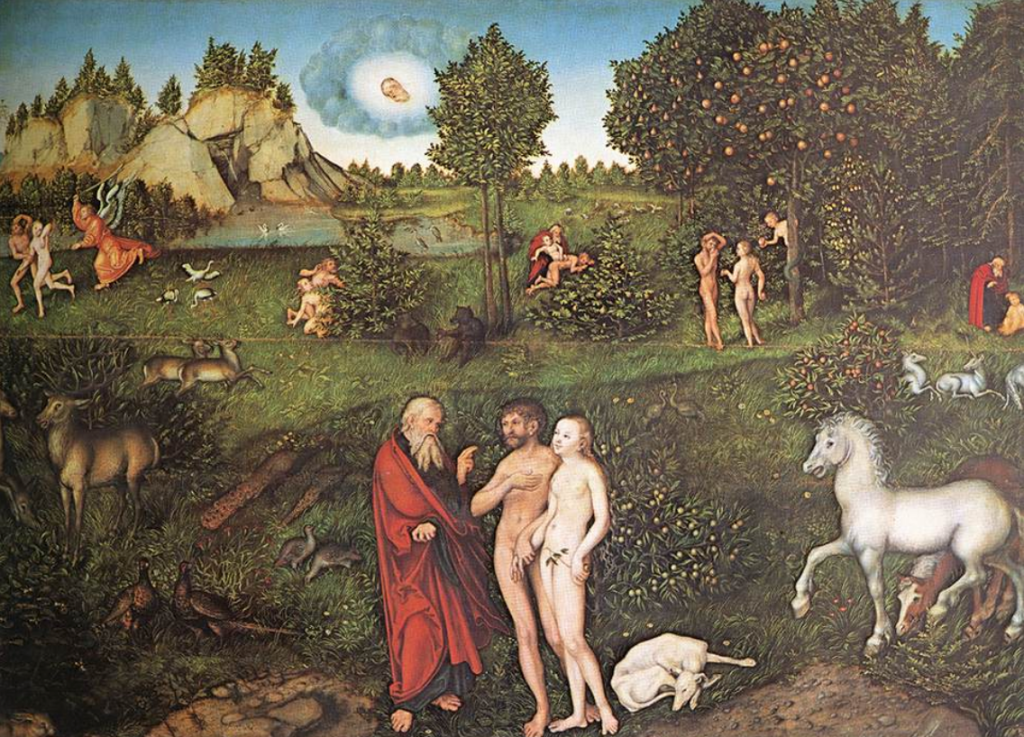
The story continues. There is a second tree, but this time God isn’t taking any chances with it: “And now, lest he put forth his hand, and take also of the tree of life, and eat, and live for ever: Therefore the Lord God sent him forth from the garden of Eden, to till the ground from whence he was taken. So he drove out the man; and he placed at the east of the garden of Eden Cherubims, and a flaming sword which turned every way, to keep the way (untouched) of the tree of life.” — Genesis 3:22–24
So much for eternal life. Again.
One could suppose, though, that if those Cherubim could be confronted and bargained with, if the flaming sword puzzle could be solved, or if thieving snakes could be guarded against, there could be eternal life for man.
What both of these stories indicate, in fact, despite the failure of all three protagonists to emulate God (or “gods” in Gilgamesh’s case), was the enterprise you might call “Project Immortality.”
Project Immortality
You see, there wouldn’t be two fruit-bearing trees in the Garden if they weren’t both to be picked… eventually. Nor would there be any plants that could be stolen away by sneaky snakes. As Chekhov remarked, if you put a gun in a story—in these cases, a fruit tree or a plant—there must be a reason for it.
It happens that some cranky people say immortality is undesirable. Well, I agree! Because if one is miserable, then life is no fun, and if life is no fun, then why, oh why, live at all? Especially forever? Horrors! (There are those, I suppose, who, despite being eternally miserable, are so afraid of death that they would prefer to live on and on in a kind of grey agony for as long as possible—more horror.)
Another argument against immortality is the very fact of sex. What would the point of sex be if everyone were immortal? The answer would be that no one is saying there’d be no death; one just wouldn’t die from old age. Things like adventure and sudden run-ins with objects more solid or durable than we are will most likely continue to take their toll. It seems like there will always be a need for procreation until the human body is so transformed that it isn’t human anymore or making bodies gets done some other way.
One could also argue that immortality would be boring. Yes! If you’re a boring person, then being bored forever would be pretty brutal! Expecting the environment to provide interest—which is not its job—is what causes the condition of boredom. (Creating interest, it appears, is the key to mental wellness and is a whole other subject, which I will cover later.) Boredom and immortality don’t go together anyway; they can’t.
Some argue that if everybody lived forever, then we would overcrowd the joint (Earth), use up all its resources, and die off anyway. Yes! True! But only if we never discover anything new, never invent anything ever again, never solve any more problems, and never evolve spiritually—in other words, cease to be, well, us!
Whatever arguments against immortality there may be, though, certainly only a misanthrope would fight extending life because the opposite of immortality isn’t the status quo, it’s extinction. Expansion, in fact, isn’t a choice; it’s a mandate. Grow or die!
Besides, when life is good (admittedly for fewer people than would be best right now), you want it to last.
As Woody Allen put it, “I don’t want to be immortal through my works. I want to be immortal by not dying.”
Extending life
So, having eaten the fruit of the Tree of the Knowledge of Good and Evil, we are learning moral behaviour: what behaviours keep us alive and which ones don’t. This must also include developing technologies: which technologies work best, that is to say, help us stay alive, and which don’t. The better we get at differentiating between what’s workable and what isn’t, the longer we live. We have been remarkably successful at this; life expectancy has seen a 160% increase from 25–28 years in classical Greece to 73 years today.
There had to be a prodigious amount of learning to achieve this extension.
First, one has to be knowledgeable about how to meet one’s immediate needs—what to eat, how not to get eaten, such as by big cats and little germs, and so forth, as well as protection from weather (clothing and shelter technologies), etc.
Second, as the environment gets under control, the basics of the body must also be learned. What bits and pieces of it do what. For instance, it was in the 16th century B.C. that the Egyptians cottoned on to the circulatory system, but it wouldn’t be until 1628 that the English physician William Harvey worked it out, and Marcello Malpighi finished the job in 1661.
As more is understood about our bodies, more is understood about the river valleys, the mountains and plains, the seas and oceans and skies, all the living things and objects therein, the sun and planets, the Milky Way, and, finally, all of space beyond: the Cosmos. All the while technologies are developed to improve conditions for human thriving. This includes medicine, replacing sick body parts with healthier body parts, and even gadgets like titanium joints and battery-operated sinoatrial nodes (pacemakers). Here lies an interesting question: how much of the body could be replaced anyway?
Transhumanism—the belief or theory that the human race can evolve beyond its current physical and mental limitations, especially by means of science and technology (not to be confused with “transgenderism,” which is a misnomer by the way; one cannot whimsically swap out x and y chromosomes, not yet anyway)—is a movement that advocates just such modifications of the human body by developing and making widely available advanced technologies that can greatly enhance longevity and cognition. (Currently, transhumanism is crawling with materialists who sneer at all things spiritual, so they won’t have much success, but we shall see.)
While all this is going on, man learns about his own divinity, which will turn out to be much more vital than it is today. I read about science, and all too often those in the “hard sciences” snigger at the efforts of those developing the so-called “soft sciences.” (A poor disposition, I’d say.) What is within man’s spiritual nature is neither in conflict nor “something else not relevant” with what is in all of nature; to know one is to know the other, and vice versa.
All this learning is not exactly one thing before the other; rather, it’s like one of those puzzles where you have to manipulate all the parts at the same time before it’s solved.
But as man learns about his body, his environment, the Cosmos and himself, he will also eventually need to work on something entirely more important than extending life: what to do with all the hard-won understanding that inevitably results in (uh oh) lots of free time.
The wisdom project
It is my contention that if most people in the West were to properly manage their money, work, and technologies—including all our “time-saving devices”—assuming we’ve already effectively broken up or gotten rid of central banking, Big Government, Big Pharma, Big Tech, etc.—we’d have twice, perhaps thrice, the amount of leisure time as we do now.
But because we are so egregiously in error about how our minds work and ignorant of true spirituality, leisure time usually results in endless manias and depressions, making it impossible not to fill up our days with lots of manic behaviours, such as ceaselessly spending more than we make, having too many sex partners, using too much drugs and alcohol, and staring like hypnotised mice at our screens—facts our overlords are perfectly happy to maximise and facilitate.
The Cherubim, real or metaphorical, represent, I believe, the actual barriers to the Tree of Life that perforce must be there until we are wise enough to pick its fruit, thereby unlocking the secrets to eternal life. I’m thinking that if you want to live forever, you’ve got to be extremely wise, or else you will get sliced, diced, and singed to a crispy critter by those flailing, flaming swords.
The goal of Scientology 1.0.0 is to eat this fruit by understanding life. The greater the understanding, the greater the wisdom. The greater our wisdom, the longer and more pleasant our lives.
To thoroughly understand and work hand in hand with the Cosmos, man is going to need to come into full harmony with it. I mean, I can’t imagine there can be much advancement for us all without this melodic cooperation. Why? Because there is always, in fact, such an immediate and automatic dissonance with Natural Law upon acting stupidly that the environment just “offs” us: bye-bye, bub! Every time!
So Homo sapiens, which means “wise man” after all, must get to know himself properly and get himself better managed, then the environment can become even better known too, and so on, back and forth. And when man as spirit and body, as well as his environment, are sufficiently understood, then a new evolutionary step could be reached: Ultra-Wise Man, or Homo Novis, as my dad called him.
One of the really great things about truly wise people is that they don’t kill their symbionts. You can always recognise this phenomenon: the foolish hunter hunts to extinction all the game; the aristocracy suppresses the peasants who just happen to be growing all the food; the socialists destroy businesses on whom they depend for all their… food! (There seems to be a pattern here: maybe idiots just don’t like chow.)
Anyway, as we become smarter and wiser, all of life will benefit. That’s why the wise citizens of rich nations spend more of their own money and time helping the environment than the people of socialist countries or poor countries are able to.
Anti-human
By the way, notice above that I said “helping” and didn’t use the politically correct terms “saving” or “protecting”.
“Save” and “protect” postulate that the environment is tragically fragile. Preaching such catastrophic fragility, which doesn’t actually exist, creates panic. The environment is not as fragile as we’re led to believe. Persons who think of the environment as needing either protection or saving at the cost of any optimum standard of living are in fact rooting for mass genocides. I mean, shutting down modern civilisation and the billions of us that are building it so we can return to the good ol’ days of 40,000 B.C., or worse, go forward to centrally controlled “smart cities” (Heil Google!), isn’t the way to go.
This whole notion that humans are somehow an enemy of life on Earth is pure, murderous claptrap and echoes Hitler’s rhetoric about Jews. Except whereas Hitler was a racist and mainly went after very specific groups (at first, anyway, I’m sure he was only getting started), the types pushing for the regulation and suppression of civilisation are actually anti-everybody—Hitler on steroids. Although undoubtedly these types are innately self-immolating, many others subscribe to this view without realising this would mean the end of them too.
Also, this theme that’s been pushed a lot recently, that the more technology humanity has, the more damage it does, is a plot right out of 18th-century sentimental literature: “civilised” man is a rapacious scoundrel, hell-bent on the destruction of all that is virtuous and beautiful, especially gentle and noble Gaia (Mother Earth). The underlying message is: “Humanity stinks! Boo to humans!”.
As I keep pounding the podium, man cannot actually progress, technically or otherwise, too much beyond his wisdom to do so; at least that’s my thesis. Sure, we have nuclear fission and fusion and mass communication via screens, which we are clearly having some trouble managing properly. But nobody said the games of man ought to be risk-free; ask any mountain climber, deep-sea diver, or even a commuter.
Pro-human
All I’m trying to say here is that humans are not the problem on planet Earth; they are the whole point of planet Earth, or Gaia, if you prefer. And not just Earth, but the whole amazing show: the Cosmos, as well as what lies above that.
However, it can and should be admitted that although the basic technologies of man have been developing for hundreds of thousands of years, people have been pretty much the same for the most part, psychologically speaking, which is a problem.
Pretty much the same until fairly recently, that is. Over the past few centuries, we’ve experienced a surge of sociability and cooperation, resulting in record highs in discoveries, inventions, and production. This was due to a shift in culture that benefited man despite his own lack of personal evolution.
Culture is the most powerful force, and the culture of man—his basic amenability to being civilised—actually civil-ised, which is to say, courteous and polite, resulted in social systems that supported more and more collaboration with his fellows. In turn, such social systems encouraged more civility.
Starting with Judaism in the Fertile Crescent and the Levant, then the Greeks, and accelerating with Christianity in Europe, slowly but surely, man became more cooperative and receptive to meeting and working with strangers, a literally deadly proposition not all that long ago.
Because of our cultural evolution, today you can go to more places than ever and be relatively free of getting bumped off. I mean, there wasn’t much of a global tourist industry even as recently as a hundred years ago or so; if you wanted to go to most places, you had better go with a garrison, which we did (called the colonial era).
This level of miraculous advancement and security leads to more networking, which leads to more advanced technologies achieved through science—both the hard sciences devoted to the technology of things and, eventually, the soft sciences devoted to the technologies of mind, spirit, and the resulting social systems—and becoming wise enough to keep them safeguarded.
The soft sciences are the missing part of the picture here and are what man needs to become ultra-wise.
Next: Hard science versus soft science.
 Arthur Ronald Conway Hubbard
3 responses to “Science, continued”
There seems to be a basic problem-we don’t know WHAT we don’t know so the challenge is knowing what to look for when attempting to understand what we don’t know. One such question is when a human being tries to understand death & beyond, if he “looks with human eyes” he won’t understand more than a human can. So it requires assuming a viewpoint beyond that of a human being. I suppose exercising that ability, the ability of imagining-creating beyond yourself…but how do you do that? How do you extend yourself beyond what you know, your experiences?
I’ve always thought, let’s say you discovered something that appears to be a new truth, you want to rest there, but there is probably a greater truth & then another more wide sweeping truth beyond those. I guess all I’m proving is that we can never stop exploring & reaching for greater harmony.
This is why I enjoy these discussions so much with other beings who are going in this direction!
LikeLike
Thank you. Matt. Yes, I’d say that when one knows “all about” something that one could otherwise expand into, it results in a kind of complacency, even seriousness, possibly even depression. There can be no end to understanding those things that lie in the infinite, which posits no limits as to how far we can go. And that’s exciting!
LikeLike
I agree. The concept & fact of infinity is possibly our most valuable key to life & living!
Thanks for writing & I look forward to your next article!
LikeLike