Understanding – Part 3
Scientology 1.0.0 – chapter 30
Click here to bring up the scale in a separate window for ease of reference.
Survival drive
“Lights! Camera (sight, sound, touch, taste, smell)! Action!”
The most basic factor in life is perception. Perception is coloured by emotion, and emotions affect action. In Scientology 1.0.0, there is a scale of emotions, the Tone Scale, a scale that represents survival drive.
Remember, in Scientology 1.0.0, “survival” means more than “the state or fact of continuing to live or exist, typically in spite of an accident, ordeal, or difficult circumstances”; it means “succeeding in overcoming counter forces in order to expand; to become more; to improve; to get better.”
The added definition stems from the non-static nature of the universe, where nothing, absolutely nothing, remains static; everything is constantly in flux. In other words there is either an increase or a decrease; there is no stasis.
Things are always either expanding or contracting, becoming more or less. Whether or not the universe is getting better or worse, who knows? As for us humans, we are either improving our ability to handle all this dynamic and constant change or we end up in Hell. Understanding natural law is the first rule in the Game of Change; the second is to either work with it or get squashed like a bug (which might hopefully explain to the more squeamish why our supposedly fearsome and vengeful God could be such an old meanie).
As for the word “drive,” it means the urge or force to move in a specified direction.
There seems to be a fundamental drive: to grow and improve—the drive for greater survival. When one fails at this, it defaults into a downward spiral, resulting in… getting squashed like a bug. One either gets better at survival or else. If you don’t want things to go blooey, then you must keep striving, as in “no rest for the weary.”
But wait! Actually, if you understand what happens when emotions below 2.0 become misemotions, you’ll notice that there appears to be a second drive: the drive toward extinction. That is to say, there is an actual urge to succumb; a person or group descends into the lower tones, and extinction appears to become the goal. In essence, life below 2.0 is so deeply unpleasant that it seems like a great idea to get it over and done with.
If such a person just got it over with and bumped themselves off, that would be one thing, but people linger in these tones for whole lifetimes, creating havoc for themselves and misery for everybody else. And forget about groups getting in this extinction frame of mind; when they get stuck, now you’ve got a whole gaggle, possibly a whole nation, bent on destruction.
Understanding this, coupled with the fact that some individuals and groups actively strive to become zippo, could potentially unlock the mystery behind a multitude of truly bizarre human behaviours. Just look through the Diagnostic and Statistical Manual of Mental Disorders, Fifth Edition to see what I’m saying, and it only catalogues the really obvious cases. Far less obvious are the many behaviours that are considered normal or even laudable, such as getting rich or famous without doing anything valuable or the deplorable U.S. federal government profiting from the deterioration of society. Other examples include the creation of fake money by devious financial cabals, the design of addictive algorithms by cunning Big Tech, the promotion of permanent illness by greedy Big Pharma, and the perpetuation of world-wide conflict to support the utterly insane military-industrial complex.
In terms of inorganic material, death seems to be neither here nor there. For “unalive” matter, one could say that the fluidity of a thing “dies” when it freezes, or the solidity of something “passes away” when it burns up and becomes smoke. As for almost all organic (alive) matter, when it dies, it transforms into compost and eventually becomes soil. Without soil, a whole lotta life cannot exist. As for us humans, though, death seems to be something of a problem. Unless we are very old, sick, or injured, we don’t particularly enjoy death. We don’t like death and would rather live for as long as possible. Most of us, anyway. Even most of those stuck below 2.0 don’t want to die; at least that’s what they say, although practically everything they’re doing almost certainly guarantees it. Yep, based on this scale, the confusion surrounding survival can escalate to the point where succumbing becomes a purpose, with death as the ultimate goal, as crazy as that may sound.
Unfortunately, many people who are aware of this scale tend to ignore its two parts, leading them to endorse individuals and groups below 2.0 with justifications such as, “Well, I really like them.” Or, “They’re not so bad.” Or “I have no choice.” Of course, it is impossible to avoid low-toned individuals and groups, such as some family members or our governments and financial institutions; whether one chooses to like or dislike them is a matter of personal preference, but one should identify and label them correctly so as to minimise any support for them. If possible, avoid supporting them altogether, especially if you value the future.
Remember the lockdowns? The government, WHO, CDC, mainstream media, Bill Gates and Anthony Fauci all employed fear tactics to maintain control over the population. To a person who properly knows this scale, this tells them that something was seriously wrong—and it weren’t just no virus neither.
The first point of knowing this scale is to help one to decipher this hard and chilling fact: persons or groups functioning below 2.0 are deadly regardless of their denials and statements to the contrary; just look at what tone level they are using to control others and the environment, and you will know their purpose. Because these benighted souls are so often continuously bloviating about their virtues, duties, and sacrifices for the betterment of this or that (and apologists are endlessly explaining the “logic” behind their actions—you know, “Hitler was only attempting to regain German lands…” utter rubbish), it can be missed that they are, at the end of the day, simply suicidal and would like nothing better than to take you along for the terminal ride. People stuck in fear, for instance, say they don’t want to die ever, really literally never, but their regular habits and routines, deeds, activities, and conduct guarantee extinction nonetheless, often sooner than later. You know: cowards die a thousand deaths before they actually die (and cowardice begins at 1.9 because every tone below 2.0 is afraid of the truth).
So, this Tone Scale is pretty useful in showing where anyone actually is regarding these two goals as well as giving a clue as to how they’re going about accomplishing them.
Above 2.0, individuals and groups are surviving more than succumbing. Below 2.0, ’tis the other way ’round.
Simplicity
“People and groups are either ‘working to get better or working to get worse’? Bah! Too simplistic!”
First, the principle of the mandate: survive! then its division into two drives might seem overly simple, a fairly common criticism regarding certain Scientology data. Perhaps this is the case, but understanding any intricate subject begins with knowing its basics. Even those subjects that are wildly complex, you know, like… life. If someone is teaching you a subject and you’re struggling to understand it, it’s likely because they haven’t adequately explained its fundamentals. The trick to understanding any subject is ensuring one first understands its foundations, which are always simple.
Take white light, for instance. White light breaks down into three colours: red, yellow, and blue. Fine. If you have good colour vision and look around, you will quickly notice two additional dimensions: tint and intensity. When you incorporate the characteristics of light sources, reflection, and absorption, the array of colours becomes innumerable. Include shape and texture and you have… everything (except for the invisible stuff, of course, which is 96.06% of the universe). From one simple factor, a whole world of colour can be studied and understood. If you’ve ever taken a comprehensive class in art, colour theory and practice are huge subjects. Little ol’ white and so much to know—so much to see! Go figure.
But when it comes to human beings, many experts in many spheres of thought regarding human psychology prefer for some reason to be bizarrely byzantine. Much of the ultra-complex psychobabble fails to grasp this fundamental truth—the simple fact of a single basic drive: survival, which can be broken down into two parts: survive and succumb. Sure, the permutations of survival and non-survival, creation and destruction are many, varied, and vastly complex; they got that right. However, this straightforward dichotomy serves as a valuable foundation for evaluating the intentions and actions of any group or individual.
Again, above 2.0 are the more survival-oriented emotions; life is the purpose. Below 2.0 are the non-survival emotions, where death is the purpose—that is, of course, if and when one is stuck in them or is experiencing them inappropriately (misemotion).
Trapped below 2.0, a person begins to destroy one or more of their many symbionts, which are essential for their own survival. For instance, a group under 2.0 might cut corners thus polluting the environment, poisoning the water table and killing off farms and there goes dinner.
The emotions related to survival lie above 2.0. 2.1, which might be called “Deep Monotony,” up to 2.8, Contented, are not particularly energetic in terms of survival behaviours, but they’re not destructive either, although they can neglect the destructiveness of others, and that’s not good.
2.9 and 3.0 are more active, but they’re still not paying enough attention to their symbionts to survive in the long run.
Above 3.0 is where reason and creativity lie. This implies that individuals are now actively shaping their own lives and the world around them, while also effectively assisting their symbionts.
Above 4.0 is self-transcendence, where lies even higher survival potential.
However, survival is impossible without understanding life.
Understanding
Going deeper, the Tone Scale represents a scale of understanding.
Understand means to comprehend, grasp the idea of, or receive from a word or words or from a sign the idea it is intended to convey. From Old English understandan, probably literally “stand in the midst of,” from under + standan “to stand.” In this context, the term “under” does not imply “beneath,” but rather originates from Old English under, which is derived from Proto-Indo-European nter-, which means “between, among.” Stand comes from Middle English stonden, from Old English standan, “occupy a place; standing firm.”
This is all about cooperation. To increase one’s chances of survival, such as by building advanced civilisations, for instance, cooperating with others, groups, and the myriad of symbionts entailed in the organic and material realms is necessary.
To figure out how to achieve cooperation, understanding life better is requisite, and a scale that shows not just what one understands, but in what way, could be useful. At the lowest point, 0.0, there is insufficient understanding and, consequently, no chance of survival. At the top, at 8.0, there is much more understanding and a great deal more survival.
In Scientology 1.0.0, the three components of understanding are affinity, reality, and communication, commonly referred to as “ARC.”
The equation is: ARC = U.
Communication
Definition: the imparting or interchange of thoughts, opinions, or information by speech, writing, or signs.
The Scientology 1.0.0 definition of communication goes somewhat further; it is the action of impelling an impulse or communication particle from a source point across a distance to a receipt point with the intention of bringing into being at the receipt point a duplication and understanding of that which emanated from the source point.
Just because people are talking at one another does not mean they are communicating, just watch most talking heads on TV. The word comes from Latin communicatus, past participle of communicare “to share, communicate, impart, inform,” literally “to make common,” related to communis “common, public, general.” When we look up “common,” it means belonging to all, owned or used jointly, general, and of a public nature or character. So, conceptually, if communication is occurring, then whatever is communicating is communing with whatever or whoever is being communicated to.
To commune means to converse or talk together, usually with profound intensity and intimacy; to exchange thoughts or feelings; to be in intimate communication or rapport. Seems to me this communing business would not occur without those so engaged understanding one another.
Conceptually, then, communication might be understood as two or more people together (between, among), standing firm (cooperating) by means of understanding one another.
Duplication
But if there is to be any actual communication, there must first be duplication.
Note my father’s definition of communication: “…with the intention of bringing into being at the receipt point a duplication and understanding of that which emanated from the source point.” This is a crucial aspect not found in other definitions of the word.
Duplication is defined as making an exact copy of something. It comes from late Middle English (in the sense “having two corresponding parts”), from Latin duplicat– “doubled,” from the verb duplicare, from duplic– which means “twofold.”
One day my dad and I were talking about learning—about acquiring knowledge in general and studying his work in particular—and I asked him about how one goes about getting people to understand Scientology. He responded, “No, no, that’s not the job. The sole responsibility is to ensure that a student duplicates the material in such a wise as they can apply it.” I puzzled over this until it dawned on me that you can’t get anyone to understand anything; that’s up to them; that’s their own determinism, but you could succeed in getting something or some subject duplicated (provided the person at the other end is willing, of course). Only after duplication, could understanding then be worked on (provided the person at the other end is willing, of course).
It could be argued that almost every conflict between two persons or groups resulted from a breakdown in communication. In such a case, an investigator might readily discover that one side did not first duplicate what the other side was trying to say. You know, such as after a massive row, Sally and John finally find out that when he said, “Watch your cat,” she thought he said, “Gosh, you’re fat.”
Although you can’t actually make someone understand your meaning—perhaps it’s beyond their comprehension, or your meaning is obscure, as it is with all esoterica, for example—you can make sure your interlocutor duplicated you and the words you used. In reverse, when puzzling over another’s communication, first make sure you duplicated them and then work out if you understood what they’re saying. This is the essence of “steelmanning,” really. Steelmanning is the practice of applying the strongest form of the other person’s argument back to them, even if it is not the one they explicitly presented. By strengthening their argument, it not only shows you duplicated their communication but also demonstrates your understanding.
Therefore, when communicating, especially complex ideas, it is advisable to ensure that what you’re saying can be duplicated and that the person receiving the communication duplicated it. Then you might work on getting yourself understood; see if you can’t get them to steelman you.
Establishing the understanding of anything is, of course, a vast subject, especially with a subject like Scientology (as I am trying to say with all these “blogs”), but without ensuring duplication of what is being conveyed as a first step, comprehension is just plain impossible.
Reality
Reality, as it is commonly defined, is the state of things as they actually exist, as opposed to an idealistic or notional idea of them. In Scientology 1.0.0, reality is simply defined as agreement as to what is.
What is, as in, the facts. This encompasses both objective reality and an individual’s thoughts, feelings, and beliefs. In many cases, sharing these sorts of things among two or more people can facilitate further communication. Bob loves Mozart, and so does Sue. This leads them to discover even more realities in common, and they become friends. One way or the other, establishing what is real between individuals and groups can only lead to further communication and the possibility of improved cooperation.
Affinity
Affinity is love or liking for something or someone. The Scientology 1.0.0 definition is: a phenomenon of space in that it expresses the willingness of someone or something to occupy the same place as the person or thing that is loved or liked.
Communication and reality without affinity aren’t going to get one very far in achieving long-term cooperation, though. Without affinity, misunderstandings regarding “what is” are bound to ensue because if the desire to occupy the same space is not established, then there’ll likely be no further communication.
So, ARC (affinity, reality, communication) equals understanding, and understanding is obviously a good thing. But what about love?
Love, as it is commonly defined, is an intense feeling of deep affection. That’s the highest degree of affinity, arguably the finest of all wave lengths. It’s a strange world, though, where the word “love” gets bandied about as much as it does, all the while any actual comprehension of the object of that love so often goes begging. This can only mean that actual ARC is missing. However, one can use affinity to initiate communication and thereby establish reality. Raising one’s liking for another brings one closer to the person or object they wish to cooperate with, facilitating further communication thus allowing one to establish a firm reality, and potentially leading to deeper affinity and cooperation
At 4.0 and higher, where proper understanding can be found, one may experience actual love for anyone or anything.
The triangle
Okay, there it is: since understanding is composed of affinity, reality, and communication, then the greater the amount of ARC, the more understanding there is.
Interestingly, though, is how connected affinity is with reality and communication; reality is with communication and affinity, and communication is with affinity and reality. For this reason, A, R, and C is depicted as forming an equilateral triangle; when one corner rises, the other two corners follow suit, maintaining the triangle’s equilateral nature and preventing it from becoming lopsided.
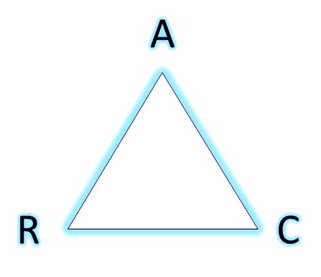
Remember alchemy? You can use this triangle for transformation, shifting from one level of comprehension (emotional tone) to a higher one on the scale. As communication improves, so does one’s reality and affinity. Enhancing one’s reality also enhances one’s affinity and communication. As one’s affinity increases, their communication also improves, which in turn enhances their reality. This process continues as one progresses towards greater levels of understanding.
Weaponisation
Of course, the reverse effect may be achieved, especially with communication, because without communication there can be no affinity, reality, or anything else, really. Remember back in chapter 2, the business with viewpoints and dimension points? That’s communication in a nutshell.
Anyway, obviously, communication can also be used to destroy ARC. By lying mostly, as is the habit of most of our mainstream media.
Just try this experiment: check your energy and aliveness and get a measure of it. Then sit down and watch thirty minutes or an hour of CNN or Fox News; afterwards, check again to see how you feel. Are you more alive, more energetic, more optimistic? No? Well, there you go: lowered ARC.
Right now reality is under attack; the usual facts are altered so that less and less agreement between people and groups might occur. Today, two plus two truly equals five. Oops!
Sum
Each tone (emotion) is a specific magnitude of ARC, and so is also a specific grade of understanding. Below 2.0 on the scale, there is less ARC, which implies limited understanding and, consequently, less “right action,” leading to decreased survival. The higher the scale, the higher the ARC, the better the understanding and the righter the actions (or inactions). If one works the triangle with attention and skill, it’s impossible not to rise up the scale.
With the levels of understanding achievable by persons in the tones above 3.0, almost automatically there comes right action, provided the correct information is at hand.
Right action is the whole point of philosophy. Understanding is the whole point of Scientology 1.0.0.
Next: ratios of matter and understanding
 Arthur Ronald Conway Hubbard
3 responses to “Survival”
Hi Arthur,
Another fascinating article thanks!!
I was going to comment the below on your blog, its been on my mind a lot lately and seems to fit with your article, from my reality, but not sure if its the sort of comment you would want.
Use it if you want.
Kind Regards Brian
In this day and age, I am struck by the amount of misinformation. I hate to say that word because it has been so skewed and used to obfuscate truths. But frankly facts are hidden from us in this society. I think if we knew our actual history as a race, knew the forces that shaped that history and knew the current forces and their actions as a group we could find agreement to go forward. Even the truths your father presented to us, so many of which proved to be true as evidenced by the working of them. The lengths to which he was attacked is staggering. I am coming to the conclusion that while those forces continue to dominate and actual truths kept from us, ARC as a group is going to be very difficult.
>
LikeLike
Thank you, Brian. I value every comment, even those that may be critical. I mean, who wants to live in an echo chamber? Your remarks, though, are exactly what I am talking about. Without accurate information, there’s no possibility of making the course corrections that are necessary to maintain a viable society. My dad’s writings from after 1950, especially those from 1951 and 1952, provide a wealth of information on this topic.
LikeLike
So real and brilliantly presented Arthur.
Thank you.
Barbara
[image]
LikeLike